The Oakley Flood: What Cincinnati Homeowners Should Know About Flood Insurance and Basement Protection
Introduction
On July 17, 2026, parts of Cincinnati's east side experienced one of the most destructive flash flooding events in recent memory. In neighborhoods such as Oakley, Hyde Park, Madisonville, and Pleasant Ridge, more than five inches of rain fell in roughly one hour, with some localized measurements exceeding six inches. The intense rainfall overwhelmed streets, storm drains, creeks, and portions of the region's combined sewer system, sending water rushing into homes, businesses, and roadways with little warning. Emergency responders conducted dozens of water rescues, hundreds of emergency calls were placed, and tragically, one person lost their life during the event. Before many homeowners had even begun drying their basements and replacing damaged belongings, another round of heavy rainfall struck the area just days later, setting back recovery efforts for countless families and business owners.
In the days following the flooding, conversations quickly shifted toward determining why the disaster occurred. Engineers analyzed rainfall data, public officials investigated whether the Duck Creek floodgate functioned as intended, residents questioned whether aging infrastructure played a role, and many debated whether the storm truly met the statistical definition of a "100 year" or even "1,000 year" rainfall event. Others pointed to the devastating Oakley flooding of 2016, questioning how such catastrophic flooding could occur multiple times within a decade. While these discussions are important for the future of Cincinnati's infrastructure, they provide little immediate guidance for homeowners wondering how they can better prepare for the next major storm. City officials have said the Duck Creek floodgate may have been one contributing factor, while the Metropolitan Sewer District has stated that the extraordinary rainfall and multiple system stresses also played significant roles.
Rather than focusing on assigning blame or debating whether these flooding events were preventable, this paper examines practical steps homeowners can take to reduce their financial and property risks before the next major storm. Regardless of whether future flooding can be completely prevented, homeowners can make informed decisions by understanding Cincinnati's unique geography, evaluating supplemental insurance options, researching their neighborhood's flood history, and considering protective plumbing measures that may significantly reduce future losses.
At The Basement Doctor, we understand the impact flooding can have because we have experienced it firsthand. In 2025, our Kentucky office flooded, giving our team a personal perspective on the challenges homeowners and businesses face during recovery. You can watch our experience here.
Why Cincinnati Is Especially Vulnerable to Flash Flooding
To understand why neighborhoods like Oakley are particularly susceptible to flash flooding, it is important to first understand Cincinnati's geography.
Often referred to as the "City of Seven Hills" or "City of Many Hills," Cincinnati is characterized by steep hillsides, narrow valleys, and neighborhoods built within natural drainage basins. While these hills contribute to the city's scenic landscape, they also influence how stormwater moves during intense rainfall events.
The principle is simple: water follows gravity.
During ordinary rainstorms, runoff is gradually collected by storm drains, creeks, retention areas, and underground sewer infrastructure. However, during exceptionally heavy rainfall, thousands of gallons of water begin traveling downhill simultaneously. As water accelerates down streets, hillsides, driveways, and parking lots, it concentrates into the lowest elevations of a neighborhood.
Unlike forests or open fields, urban environments contain large amounts of pavement, concrete, rooftops, and other impermeable surfaces. These surfaces prevent rainwater from soaking into the ground, causing significantly more runoff to enter municipal drainage systems within a very short period of time.
When rainfall exceeds the capacity of those systems, water has nowhere else to go. Streets begin acting as rivers, storm drains surcharge, creeks rise rapidly, and low-lying homes become increasingly vulnerable to flooding.
For homeowners, understanding whether their property sits within one of these natural collection points can be just as important as understanding the age of their roof or foundation. Homes located at the bottom of hills, at the end of descending streets, adjacent to drainage swales, or near creek corridors may face greater exposure during extreme rainfall events than neighboring homes located only a few hundred feet away.
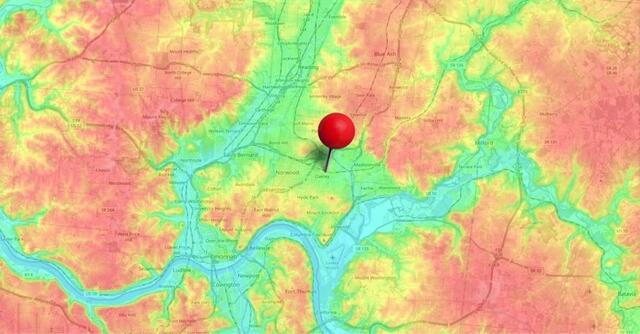
Cincinnati is often called the "City of Seven Hills" because of its dramatic elevation changes. This map provides a broad view of the hills and valleys surrounding Oakley, highlighted at the center. However, flooding risk is often determined by smaller elevation changes within a neighborhood. These subtle slopes and drainage paths, known as microtopography, can influence where stormwater collects during intense rainfall.
Understanding Flood Insurance
One of the most common misconceptions surrounding flooding is the assumption that standard homeowners insurance will cover any water damage that occurs inside the home. Unfortunately, that is often not the case.
Most standard homeowners insurance policies are designed to protect against sudden and accidental events occurring within the home, such as burst plumbing pipes, appliance failures, or roof leaks caused by covered perils. However, damage caused by rising surface water, overflowing streams, flash flooding, or stormwater entering from outside the structure is typically excluded unless a separate flood insurance policy has been purchased.
For many homeowners affected by the recent Oakley flooding, this distinction became an unfortunate reality. Because Oakley has not historically been viewed as a high-risk flood area, many residents understandably assumed flood insurance was unnecessary. Yet the recent storms demonstrated an important lesson: while flood risk maps identify areas with the highest probability of flooding, flooding itself is not limited to designated flood zones. Flash floods can occur wherever intense rainfall overwhelms the landscape and existing drainage infrastructure.
Flood insurance is designed specifically for these types of events. Policies generally help cover structural damage to the home caused by flooding and, depending on the policy selected, may also provide protection for personal belongings damaged during the event. While premiums vary based on location, elevation, and coverage limits, many homeowners outside traditionally mapped floodplains can obtain coverage at relatively affordable rates compared to the potential financial consequences of a major flood.
As Bobby Miles, Owner of The Basement Doctor, often explains, the value of flood insurance is not measured by how often it is used, but by the protection it provides when an unlikely event does occur.

"For many homeowners, adding flood insurance may cost only a few hundred dollars each year. While everyone hopes they never need it, that additional coverage can save thousands—or even tens of thousands—of dollars after a major flood. If your home sits near the bottom of a hill or in an area where water naturally collects, it's worth researching your neighborhood's flood history and discussing your coverage options with your insurance provider."
Rather than assuming a property is safe simply because it has never flooded before, homeowners should take time to evaluate the unique characteristics of their neighborhood.
How Homeowners Can Better Understand Their Flood Risk
Unlike coastal flooding, flash flooding often affects neighborhoods in highly localized ways. Two homes separated by only a few blocks—or even a few houses—may experience vastly different outcomes during the same storm depending on their elevation, surrounding terrain, and nearby drainage patterns.
Fortunately, homeowners can take several practical steps to better understand their property's potential flood risk.
One of the simplest methods is to observe the surrounding topography. Does the roadway slope toward the home? Does stormwater naturally flow toward the property during heavy rain? Is the house positioned near the lowest point of the street or subdivision? Homes located at the base of hills, at the end of descending roadways, or within natural drainage paths often experience greater concentrations of runoff during intense storms.
Speaking with long-time neighbors can also provide valuable insight. Residents who have lived in the neighborhood for decades may remember previous flooding events, identify streets that routinely collect water, or explain how drainage patterns have changed as surrounding development has increased.
Historical information is another valuable resource. Searching online for previous flooding events within a neighborhood, reviewing local news reports, examining historical rainfall records, and consulting publicly available flood mapping resources can help homeowners gain a better understanding of how their area has responded during past storms. While no resource can predict exactly when future flooding will occur, understanding a property's history can help homeowners make more informed decisions about insurance coverage and mitigation efforts.
Flood risk should not be viewed as a simple yes-or-no question determined solely by a FEMA flood map. Instead, it is more accurately understood as a spectrum influenced by geography, rainfall intensity, neighborhood development, and the capacity of local stormwater infrastructure.
Sewer Backup Coverage: Protection Many Homeowners Overlook
Surface flooding is only one way water can enter a home during an extreme rain event. Even properties that remain dry on the outside may still experience significant water damage if municipal sewer systems become overwhelmed.
Many Cincinnati neighborhoods are served by extensive underground sewer infrastructure that transports both stormwater and wastewater through interconnected systems. During exceptionally heavy rainfall, enormous volumes of water enter these systems in a relatively short period of time. If the amount of incoming water exceeds the system's capacity, pressure can begin building within underground sewer mains.
When this occurs, wastewater and stormwater may seek the path of least resistance. In some homes, that path is through basement floor drains, utility sinks, shower drains, or lower-level plumbing fixtures. Instead of water flowing away from the home, it reverses direction and enters the basement through the plumbing system itself.
This type of loss differs from traditional flooding because the water originates from the sewer system rather than directly from rising surface water. Unfortunately, many homeowners discover after the fact that damage resulting from sewer backup is also commonly excluded under standard homeowners insurance policies unless additional sewer backup coverage has been added.
For this reason, many insurance professionals recommend that homeowners review both their flood insurance options and the availability of sewer or water backup endorsements with their insurance carrier. Although these coverages protect against different types of water damage, they can complement one another by addressing multiple pathways through which water may enter a home during severe weather.
Backwater Valves: An Additional Layer of Protection
While insurance helps homeowners recover financially after a flood, certain plumbing improvements may help reduce the likelihood of sewer backup occurring in the first place.
One such improvement is the installation of a backwater valve by a licensed plumbing professional.
A backwater valve is designed to allow wastewater to flow out of a home's plumbing system under normal conditions while preventing reverse flow if municipal sewer lines become pressurized. During a sewer surcharge event, the valve automatically closes, helping block contaminated water from flowing backward into the home's plumbing fixtures.
Although no plumbing device can guarantee complete protection during every flood, backwater valves have become an increasingly common recommendation for homes located in areas susceptible to sewer backup. It is important to recognize, however, that they do not prevent damage caused by surface flooding entering through doors, window wells, foundation openings, or other exterior pathways. Instead, they specifically address one of the most common causes of basement flooding during extreme rainfall: reverse flow from the municipal sewer system.
When combined with appropriate insurance coverage, proper property maintenance, and an understanding of neighborhood flood conditions, backwater valves can serve as one component of a broader flood preparedness strategy rather than a standalone solution.
Conclusion
The recent flooding in Oakley served as a powerful reminder that extreme weather can impact communities regardless of whether they are located within a designated flood zone. While engineers, government officials, and community leaders continue evaluating the causes of these events and discussing how future flooding can be mitigated through infrastructure improvements, homeowners do not have to wait for those long-term solutions before taking action. By understanding Cincinnati's unique topography, researching the flooding history of their neighborhood, evaluating both flood and sewer backup insurance coverage, and considering protective measures such as professionally installed backwater valves, homeowners can significantly improve their preparedness for future storms. Although no home can be made completely immune to flooding, informed decisions made today can greatly reduce tomorrow's financial losses, property damage, and disruption. As weather patterns continue to produce increasingly intense rainfall events, preparation remains one of the most effective tools homeowners have to protect both their homes and their peace of mind.